Everyone Thinking
Classroom habits that make thinking the norm

I’m at the door, handing out a starter task as students come in, already braced for the stream of questions…
“Do I need a pen?”
“Do we stick this in?”
“Where shall I put the homework?”
“What’s the date?”
“Can I sit here today?”
I’ve barely had time to say pens don’t “just explode” and somehow 10% of the lesson has vanished.

This was my normal for years. Not just lesson starts but every phase. Explaining the task, re-explaining the task, where to write, what to cut out, what to stick in, who to work with, and what to do next.
At the time I thought this was just what teaching was. And it was reinforced as good teaching in observations and CPD. Complex role plays, card sorts and colouring activities were celebrated. Variety was the name of the game.
I got better at inventing activities… relate the game to the curriculum, teach the rules, manage the noise, contain the chaos. And learning presumably happens. Except it didn’t and I could not understand why.
Ratio, ratio, ratio
Enter Rosenshine, whose paper Principles of Instruction was published in 2012, the same year I trained. Yet it wasn’t in any of the training or CPD I received until many years later. I remained shamefully unaware of this work until I began to search for reasons my growing collection of card sorts was not leading to improved outcomes.
Reading Seven Myths of Education was an absolute game changer for me. Christodoulou articulated a frustration which had been simmering in me, which I couldn’t quite put my finger on. She brilliantly put into words the frustration (and excitement) I felt when I realised some of the most useful ideas about learning had simply never been shared with me during training. And that much of the training received had no evidence to back it up.
It wasn’t until I discovered Teach Like a Champion that I was prompted to reconsider the reason I do any activity and began to make changes. The concept of participation ratio and think ratio resonated strongly: the idea that a lesson episode can be viewed through the lens of ‘is everyone thinking?’ and ‘is everyone thinking hard?’.
Thinking as a classroom habit
But how? Lesson episodes are not independent of each other. This isn’t something which can be fixed with isolated techniques. It needs a classroom culture of 100% participation and sky-high expectations of everyone in the room.1
Participation and thinking are not techniques, but habits which are built over time, woven into the culture of a classroom. The change in my own teaching did not come from one killer activity, but from a kind of ‘critical mass’ where enough phases of the lesson had high participation built into them that thinking was not invited, but expected. Starters, explanations, quizzes, home learning all carried the same message: Everyone participates, everyone thinks.
Once these routines were embedded, my job became easier because I was thinking less about logistics and more about ratio. The students’ job became easier because they were thinking less about what to do and more about the content.
Many years later and my lesson planning boils down to one idea, increase ratio at every opportunity. I even stuck this graph to my desk to prompt me to use this lens in my planning.
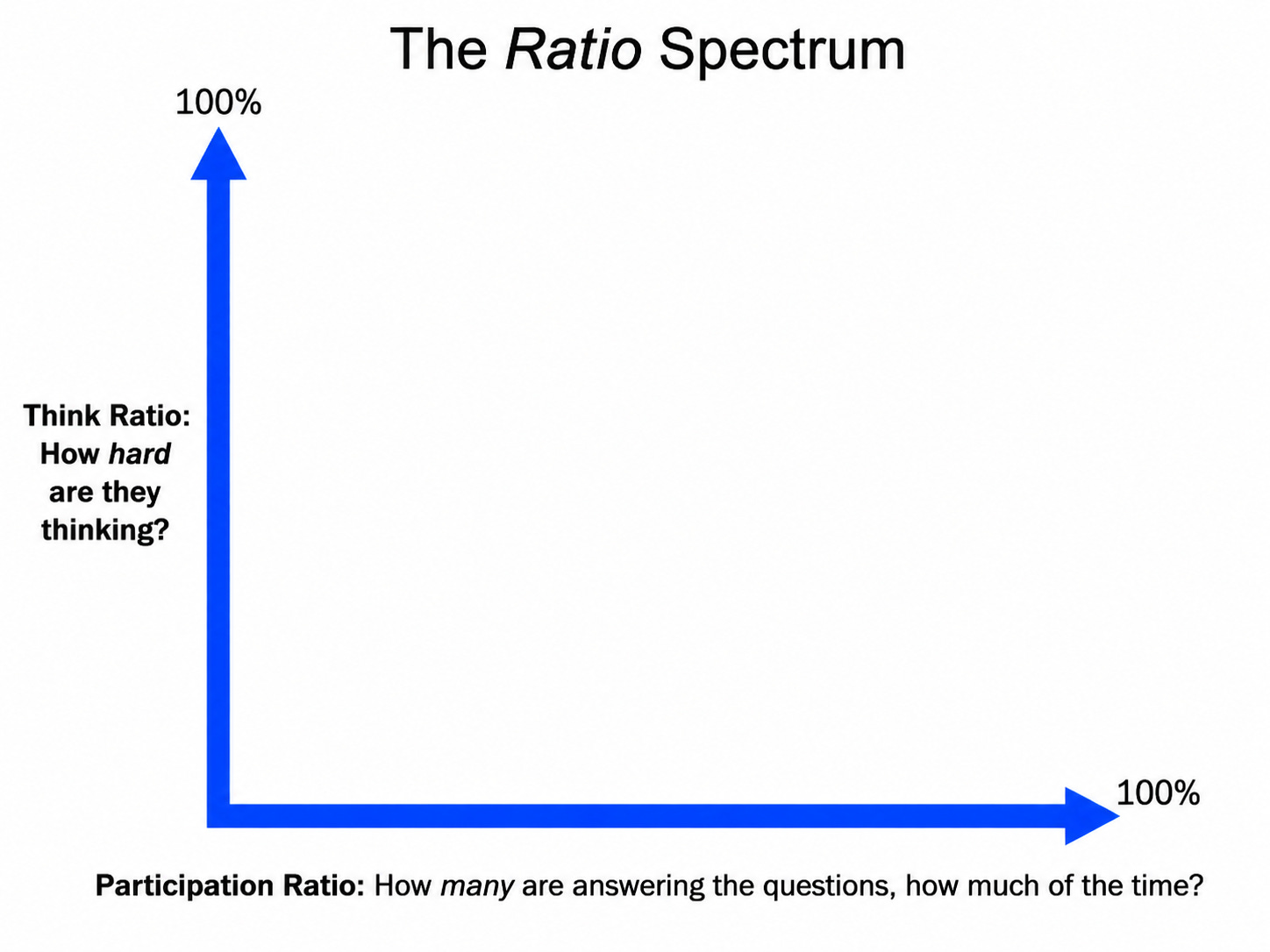
I also began using the same lens when observing lessons, including my own on video. Not just ‘was the explanation clear?’ but ‘who was thinking, how hard, and for how long?’
No Opt Out as a classroom norm
In Teach Like a Champion, Lemov defines No Opt Out as a strategy for encouraging thinking during cold-call. It is often used with Right is Right where the teacher holds out for the complete answer2:
What’s a covalent bond… [think time]... Jonny?
An electron between two atoms?
You’re halfway there, what is Jonny missing?...
…[think time]...
Theresa, what can you add?
He didn’t say a pair of electrons, sir
Right! What’s a covalent bond, Jonny?
A shared pair of electrons between two atoms
But I think the principle could be used more widely:
During a mini whiteboard task insisting everyone writes something, even if they are unsure. A first step, a key word, part of the question they don’t understand.
By assigning roles in a turn and talk… Person A talks first, then person B.
By expecting students to correct or improve answers rather than simply tick or cross them.
Each of these individually is nothing special, and they are explained in depth elsewhere. But when enough are used together, with consistency, students receive a clear message that participation and thinking are the classroom norms. Opting out is not how we do things here… Everyone contributes, mistakes are expected, and we support each other to be excellent.
What really made the idea click for me was Tom Bennett’s writing on routines. In Running the Room, Bennett writes extensively about the importance of building consistent routines, or norms, until they become automatic. Once I realised that thinking is a behaviour too, high participation stopped looking like the result of isolated techniques, and started to look like dozens of small habits which normalise attention, accountability and thinking.
This isn’t to say specific techniques don’t matter. They obviously do, and they should be chosen carefully. My point is that a small number of classroom strategies, built into consistent routines, is far more powerful than trying to crowbar all 63 techniques from Teach Like a Champion 3.0 into a 50 minute lesson.
Predictability reduces anxiety and frees up cognitive load. Students spend less time thinking about logistical fluff, and more time thinking about the thing I actually want them to learn. That makes learning more efficient. It gives them a better chance of feeling successful. Success, repeated often enough, is where real enjoyment of a subject begins.
But maybe I’ll still invest in some non-exploding pens…
Including myself.
Techniques 15 and 16 in Teach Like a Champion 3.0
Another excellent article. It's the combination of these techniques that really builds attention and participation.